Designer Diaries: “What's the Total Cost Going to Be? (And How Do I Keep It From Spiraling?)”
Okay. The cost of hiring me is one conversation, and we had a version of it already. But there's a bigger, scarier number lurking behind it, and it deserves its own honest talk. That's the total. The furniture. The stuff. The rugs and lighting and the hundred things a room actually needs. The "wait, how on earth did we get here" figure at the bottom of the page that people lie awake worrying about.
I get it. That number feels uncontrollable, like it has a mind of its own. So let me take the fear out of it, because in my experience the spiral is almost never what people think it is.
Here's the thing most people get backwards: the budget spiral doesn't come from working with a designer. It comes from working without a plan.
When you tackle a home room by room, piece by piece, decision by decision, with no map and no total in mind, that's when the numbers quietly creep up on you. A little splurge here. An impulse buy there. A return you eat the shipping on. A thing you bought, lived with, hated, and replaced. It's death by a thousand throw pillows, and it happens precisely because there was never a number to measure against in the first place.
A budget you can see is a budget you can control. A budget that lives only in the back of your mind is a budget that runs away from you. So here's how I keep the whole thing grounded, start to finish.
We set the number first. Before we design a single thing, we have a real, honest, no-flinching conversation about what you actually want to invest in this project. Not a fantasy number, not a number you're embarrassed by, the real one. I promise I've worked within it before, whatever it is. This conversation feels vulnerable for a lot of people, and I want to normalize it: telling your designer your budget isn't revealing a weakness, it's handing me the most important tool I have for serving you well.
The plan respects the number. This is the part that separates a professional from a wish. I design to your budget, not around it while quietly hoping you won't notice the total creeping past it. If your number and your wish list don't match, I tell you early, and we make real choices together. Nobody gets to the end and discovers the plan cost double what you said. That's a failure of the designer, not the budget.
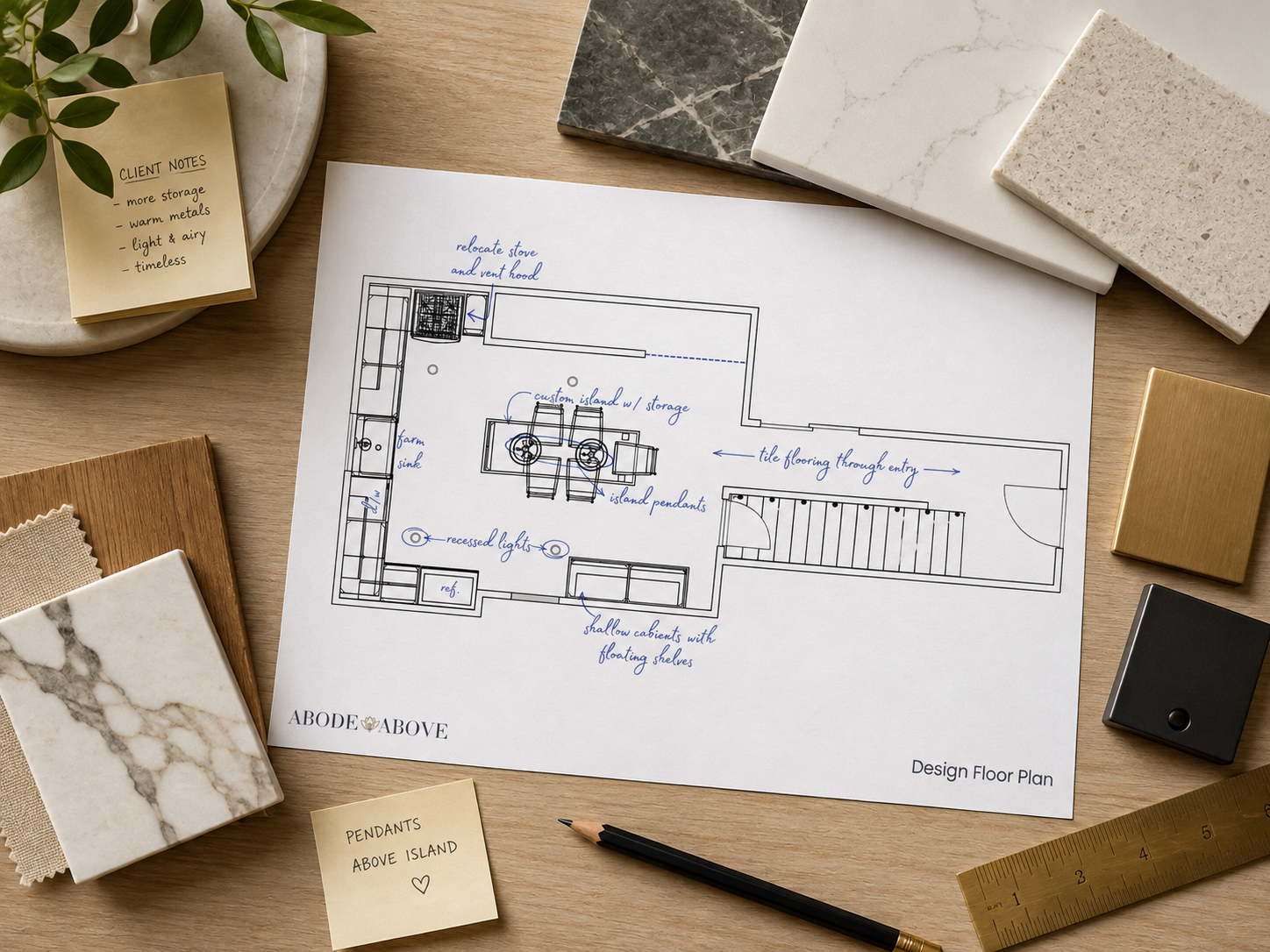
You see where every dollar goes. Sofa, rug, lighting, art, install, all of it, laid out so you can see the whole picture. No mystery line items, no vague "furnishings" bucket that could mean anything. When you can see the breakdown, you can make smart trades. Maybe the lighting matters more to you than the side tables. Great, now we can move money toward what you care about, on purpose, instead of by accident.
We decide together where to invest and where to save. This is my favorite part, honestly, because it's where experience really earns its keep. Not everything in a room needs to be the splurge. Some pieces are worth every penny because you touch them daily, sit on them, sleep on them, and cheap versions fall apart or feel bad. Other pieces nobody will ever know you saved on, because at that spot in the room, the expensive version and the smart version look identical. Knowing which is which, item by item, is a huge part of what you're actually paying me for. I'll tell you where to put your money and where to keep it in your pocket.
A couple more tools I use to keep the total from becoming a monster, because knowing the mechanics takes away a lot of the fear.
We can phase it. A budget spiral often comes from trying to do everything at once and panicking at the combined total. But a good plan can be built to unfold in stages. We design the whole vision up front, so every piece is chosen to work together, and then we execute it in waves as your budget allows, this season, next season, the season after. You get a coherent end state instead of a patchwork, but you spread the spend across time so it never lands as one overwhelming number. The key is that the plan exists in full from the start. Phasing a plan is smart. Phasing with no plan is just the spiral in slow motion.
We build in a cushion for the unexpected. Real projects have surprises. A piece gets discontinued, a price shifts, you fall in love with something a little above where we'd slotted it. A budget with zero room for any of that is a budget that breaks the first time reality shows up. So a professional plans for a reasonable contingency from the beginning, which sounds like it costs more but actually does the opposite: it keeps one surprise from blowing up the whole thing, because the cushion was already there to absorb it. Amateur budgets assume everything goes perfectly. Professional budgets assume it won't, and stay calm when it doesn't.
Let me push back on one belief while I have you, because it holds people back: the idea that a budget is a cage. It isn't. A budget is the exact opposite of a cage. It's the thing that lets you actually enjoy the process instead of bracing for the total the whole way through. When you know the number and you know the plan fits inside it, you get to relax and have fun choosing between two great options, instead of white-knuckling every decision wondering if this is the one that breaks the bank. Constraints don't kill creativity. They focus it. Some of my best work has happened inside a tight number, because a clear limit forces sharp, intentional choices instead of scattered expensive ones.
I want to spend a moment on the budget conversation itself, because it's where a surprising amount of the spiral actually begins, before a single thing is purchased. A lot of people, when asked their budget, name a number lower than the truth. Sometimes out of embarrassment, sometimes as a negotiating instinct, sometimes because they genuinely haven't thought it through. I understand the impulse completely, but I want to name why it backfires. If I design to a number that isn't real, one of two things happens. Either I deliver a plan that fits the stated number but leaves you quietly disappointed because it couldn't reach what you actually wanted, or you start adding "just one more thing" past the fake ceiling, and now you're back in the spiral, over a budget that was never true to begin with. The most powerful anti-spiral move you can make is radical honesty about the real number, up front. It's the single input that lets everything downstream stay on track. There is no budget I'm going to judge. There's only the budget I can or can't design well against, and I can only know which if you tell me the truth.
There's one more quiet cost worth naming, and it's the cost of doing nothing. A lot of people avoid making any plan because the total scares them, so they live for years in a space that doesn't work, slowly buying and rebuying and never quite landing. Add up five years of "good enough" purchases and false starts, and it often rivals the cost of just doing it right once. Paralysis has a price tag too. It's just hidden.
So if that big number is the thing standing between you and a home you love, the answer isn't to avoid the number. It's to get your arms around it. Name it, plan to it, and watch it stop being scary.
Want me to look at your actual space and give you a realistic range before you commit to anything at all? That's exactly what a consultation is for. No pressure, no obligation, just a clear-eyed conversation about what your project might really cost and how to make your number work as hard as it can.